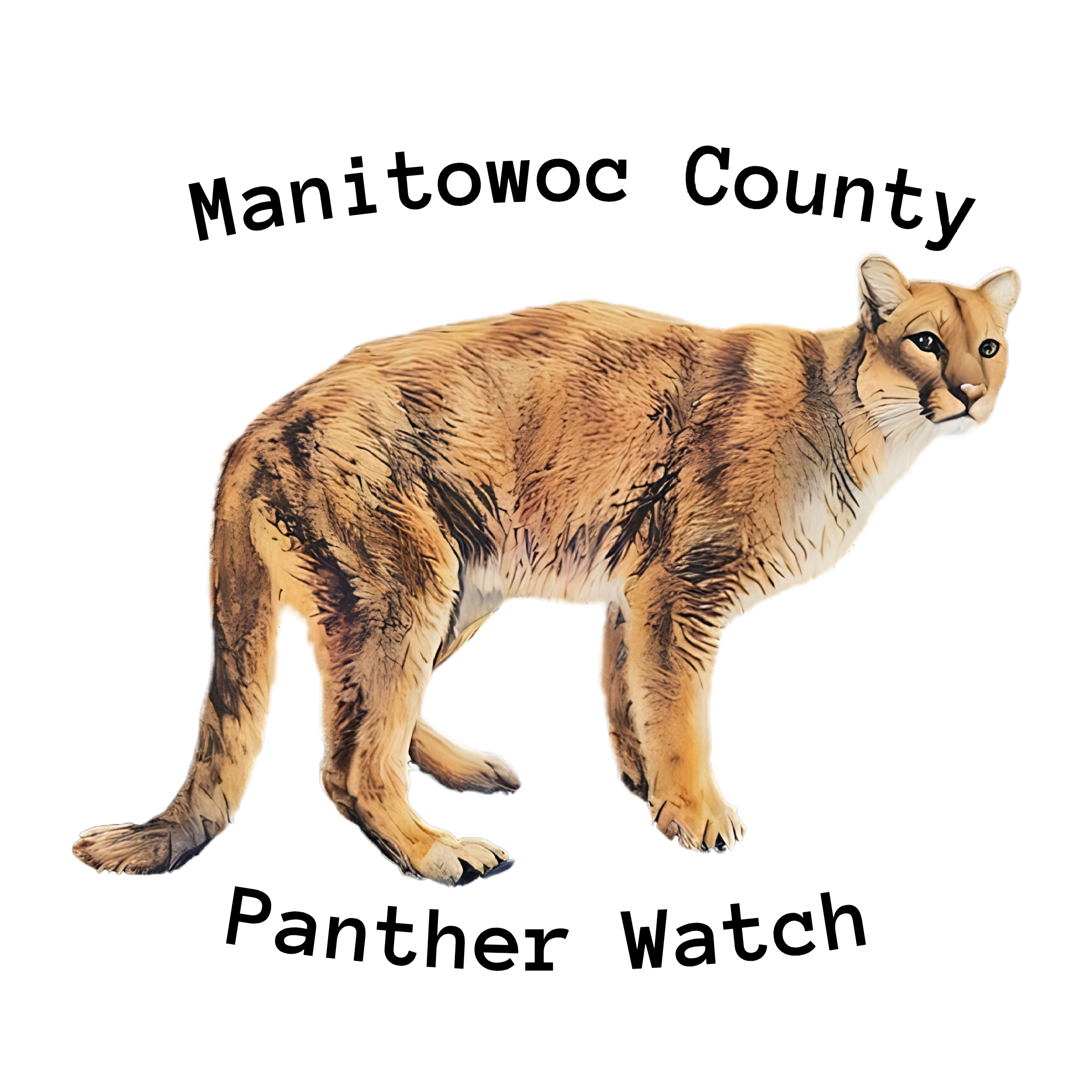
Documenting Elusive Predators
Manitowoc County Panther Watch is dedicated to tracking, documenting, and protecting potential mountain lion and panther populations in Wisconsin's forests and farmlands. Through scientific observation and community reporting, we build awareness of these magnificent creatures that may once again be establishing territory in our region.
Knowledge Center
Identifying Panthers & Mountain Lions
Mountain lions (Puma concolor), also known as cougars, panthers, or pumas, are the second-largest cat in North America. Adult males typically weigh 110-180 pounds and measure 7-8 feet from nose to tail tip.
Key identification features include:
- Tawny, light brown to reddish coat
- Long, black-tipped tail (approximately 2/3 of body length)
- Black markings on face, ears, and tail tip
- No spots or stripes when mature
- Low-pitched calls rather than roars
Note: Panthers are often confused with bobcats, which are smaller with spotted coats, shorter tails, and tufted ears.
Margin Notes — Field Identification
Track width: 3-4 inches across, asymmetrical, four toes with no claw marks visible (retractable claws). Mountain lion tracks are significantly larger than domestic cat prints but can be confused with canine prints. Note the distinct M-shaped heel pad and lack of nail impressions.
Habitat & Territory Range
Mountain lions historically ranged throughout Wisconsin but were largely extirpated by the early 1900s. Recent confirmed sightings suggest a potential reestablishment of small populations, particularly in remote forested areas.
Preferred habitats include:
- Dense forest with rocky outcroppings
- River corridors and riparian zones
- Areas with abundant deer populations
- Remote locations with minimal human disturbance
A single male mountain lion may maintain a territory of 50-150 square miles, while females typically occupy 25-60 square miles. Their secretive nature and primarily nocturnal habits make direct observation extremely rare.
Margin Notes — Manitowoc Habitat
Manitowoc County's mix of agricultural land, river corridors, and fragmented forest patches provides potential movement corridors for dispersing cougars. The Point Beach State Forest and nearby Kettle Moraine areas offer more substantial habitat blocks. Limited human population density in rural areas creates potential refuge zones.
Recent Sighting Documentation
The Manitowoc County Panther Watch has documented several potential mountain lion sightings in recent years. While many reports remain unconfirmed, a growing body of evidence suggests occasional presence of these elusive predators.
Confirmed evidence includes:
- Trail camera footage (2021, 2023)
- Verified track casts (multiple locations)
- Hair samples confirmed by DNA analysis
- Consistent eye-witness accounts matching specific criteria
We maintain strict verification protocols to ensure scientific validity, with all evidence examined by wildlife biologists. Many reported sightings turn out to be misidentifications of other wildlife or domestic animals.
Report a Sighting
If you believe you've seen a mountain lion, please document the following:
- Date, time, and precise location
- Photos or video if possible
- Size relative to known objects
- Behavior and movement patterns
Research Initiatives
The Manitowoc County Panther Watch coordinates several ongoing research programs to document and understand possible panther populations in eastern Wisconsin.
Current research projects include:
- Remote trail camera monitoring network across 24 strategic sites
- Environmental DNA sampling in potential travel corridors
- Habitat connectivity analysis using GIS mapping
- Community science reporting system with verification protocols
- Historical record compilation dating back to 1800s
We collaborate with the Wisconsin DNR, University of Wisconsin wildlife biology department, and other research institutions to maintain scientific standards and share findings.
Research Findings (2023)
Our 2023 field season documented three potential mountain lion encounters that passed initial screening protocols. One trail camera image from the northern county boundary showed a large cat-like figure with consistent morphology and movement patterns.
Track casts collected near Point Beach State Forest measured 3.7" in width with typical mountain lion characteristics. Hair samples recovered from the same area are pending DNA analysis.
While these findings do not conclusively establish a resident population, they suggest occasional presence of dispersing individuals, most likely young males seeking new territory from established populations in states further west.
Contribute to Research
Our work depends on community involvement. You can contribute by:
- Hosting a trail camera on your property
- Reporting potential tracks or signs
- Volunteering for field surveys (training provided)
- Supporting our equipment fund for DNA analysis
Conservation & Coexistence
Mountain lions play a vital ecological role as apex predators, helping to regulate deer populations and maintain ecosystem health. Their potential return to Wisconsin represents a significant conservation success story.
Our conservation principles include:
- Evidence-based population monitoring
- Habitat corridor preservation and connectivity
- Community education about coexistence strategies
- Responsible management protocols in collaboration with state wildlife agencies
- Support for policies that balance ecological and human needs
We advocate for science-based approaches that recognize both the ecological value of these magnificent predators and the legitimate concerns of farmers, pet owners, and outdoor recreationists.
Coexistence Strategies
Mountain lions naturally avoid human contact. The risk of negative interactions is extremely low, but simple precautions can further minimize risk:
- Keep pets supervised outdoors, especially at dawn and dusk
- Secure livestock in protected enclosures overnight
- Install motion-activated lighting around barns and outbuildings
- When hiking, travel in groups and keep children close
- If encountered, appear large, make noise, and back away slowly
Remember: Mountain lions are not seeking human interaction and will typically retreat when aware of human presence.
Conservation Partners
We work closely with:
- Wisconsin Department of Natural Resources
- Great Lakes Predator Alliance
- University of Wisconsin Wildlife Ecology
- Manitowoc County Land Conservation
- Local landowners and conservation easements
Join Our Tracking Network
Subscribe to our quarterly field notes for sighting updates, research findings, and community science opportunities.
Investigated
Cases
Cameras
Volunteers